
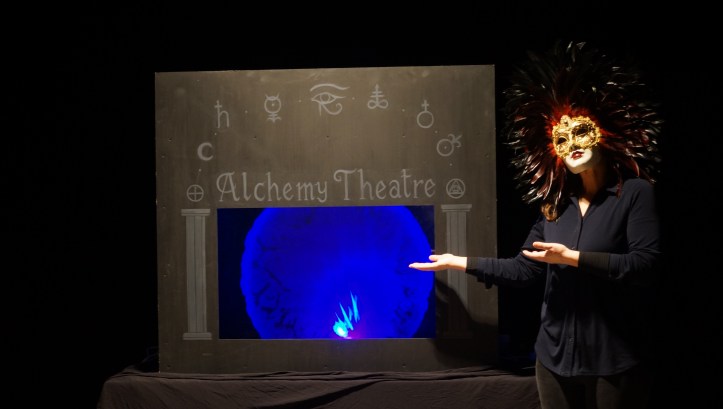
I am heading to Istanbul to present my research on the Eidophusikon and my development of the Alchemy theatre to the Association for Adaptation Studies.
The Alchemy Theatre project brings to life a contemporary reimagining of Philippe de Loutherbourg’s Eidophusikon—a late 18th-century spectacle of illusion, light, and movement once described as a “small theatre for representing natural phenomena.” In reviving this forgotten art form, Alchemy Theatre does not aim for historical reconstruction alone, but instead seeks to transform the original into a living, breathing work of contemporary art.
My research began with an exploration of Loutherbourg’s involvement in the Occult Revival of the 18th century, particularly his engagement with alchemical thought. This led me to consider the idea of the Sublime—not merely as an experience of awe inspired by nature, as was typical of the period, but as an internal, spiritual encounter with the unseen. In an age saturated with spectacular images of nature, I wanted instead to explore a Sublime rooted in the imagination and in the world of Spirit.
This spiritual dimension was further informed by the writings of Emanuel Swedenborg, a philosopher and mystic whose influence on Loutherbourg was profound. Swedenborg’s ideas—along with the archives and support of Swedenborg House in London—shaped both the conceptual and visual language of the theatre.
Artists contributing to the project submitted their work as digital files, regardless of their original medium. These images were printed, cut, and collaged into sliding scenographic panels inspired by the principle of “six separations,” which organize the visual space of the theatre. The miniature stage requires at least three performers to operate; like the original Eidophusikon—and its modern counterpart in Hamburg—it comes alive through manual, collaborative labour. Our version does not conceal this. The rods, the painted hands, the visible effort of performance—all remain exposed. In this way, the process itself becomes part of the experience.
The soundscape combines live music with a backing track, while lighting effects—from handheld torches to projected 35mm slides—infuse each scene with rhythm and atmosphere. I continue to experiment with these mediums, questioning the role of digital technology and analogue methods, and allowing the work to shift between tradition and innovation.
This act of adaptation—part re-creation, part reinterpretation, part repurposing—asks how historical forms can be not only preserved but reimagined. Like Loutherbourg’s original, Alchemy Theatre seeks to evoke the Sublime. But this is a Sublime for our time: layered, unstable, interior—a 21st-century Sublime.
 Art and Magick