
I explore the fascinating world of spirit art and its origins at London’s historic College of Psychic Studies
While researching the enigmatic de Loutherbourg and his circle of spiritually inclined artists, I was intrigued by the absence of what we now call “spirit art.” Despite knowing its existence and recent resurgence, I felt compelled to delve deeper into this captivating art form. My journey led me to the Georgian gem of the London College of Psychic Studies in South Kensington.
Renowned for its extensive collection of spiritual paintings, the College offers a unique opportunity to explore the intricacies of spirit art. This artistic practice, rooted in the belief of invoking metaphysical entities for inspiration, has a rich history and continues to captivate audiences today.
Spiritual art (or “spirit art”) is the practice of invoking metaphysical creatures to inspire and aid in the creation of art. The College has numerous distinct examples in their collection.
What is Spirit Art?
Many spiritualist painters claimed inspiration from spirits or the dead. This is demonstrated in automatic writing and drawing. ‘Mediumistic’ art draws spiritually from the dead and transfers their vitality to the living. ‘Spirit’ art can summon many spirits, not simply the dead. Its spiritual or mystical foundations set it apart.
Typically, such art investigates spirituality, deities, the soul, the afterlife, and the physical-spiritual connection. This includes ghosts, angels, and other ethereal beings, as well as symbols such as light (indicating divinity or enlightenment), nature, and abstract artwork that represents transcendence or higher awareness. It differs from traditional Christian religious art – though not necessarily in style. It’s more of an interpretive difference. For example
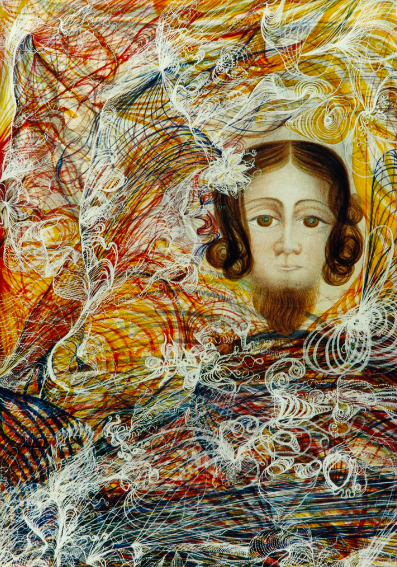
Georgiana Houghton
c.1862
Houghton’s depiction of Christ is completely different to what we’ve come to expect from Christian art.
What is Spirit Art About?
Spirit art frequently explores grief, loss, hope, and the human experience of mourning. Artists occasionally create images of imaginary or deceased people to represent their essence or spiritual presence. The emotional intensity is intended to resonate with viewers. Many of the paintings in the collection are dreamlike, featuring soft colors, flowing patterns, and unclear places that conjure magic.
Spirit art frequently shows the earthly-spiritual connection through nature. Trees, water, and stars are common subjects in photographs. Spirit art and the occult are not inherently linked, but you can sometimes detect occult aspects in other esoteric traditions that study unseen forces. Artists may depict or indeed employ ceremonies or rituals to highlight spiritualism’s communal aspect.
Traditional instruments are utilized for spirit drawing and painting. The artist meditates and seeks spiritual guidance. This is extremely close to the later Surrealists’ Freudian ‘automatic sketching.’ The finished works generally include images, patterns, or symbols that the artist had no control over. The creator believes the painting allows spiritual elements to communicate.
Why were artists drawn to spiritualism?
The question of why artists were drawn to spiritualism is a good one, and to find the answer, we do actually need to go back a century to Loutherbourg’s time. In my research, I’ve found it remarkable how many artists in the late 18th century were either deeply involved in, or dabbled in, or were on the fringes of, the Occult Revival of the late 18th century. Loutherbourg was, as I’ve discovered and is generally known to those who are aware of him, very deeply involved in alchemy and ceremonial magic. Some of his friends were as well, including the painter Richard Cosway and the sculptor John Flaxman. Flaxman is very well known as an acclaimed sculptor, but it’s not generally known about him how deeply involved he was in the esoteric. It’s an interesting question about how much the architect John Soane was involved in the esoteric; he was a friend of Flaxman and Loutherbourg – in fact, he created Loutherbourg’s tomb when the artist died. Of course, people didn’t necessarily have to be practitioners to be influenced by and aware of the occult ideas swirling around late 18th century London.
But for all that, the artists didn’t seem to have been making artworks depicting or invoking spiritual subjects or themes. Loutherbourg made sublime landscapes, but they were realistic—however imbued with thrilling aspects. Flaxman was concerned with accurate and beautiful renderings of human forms—of actual people. Only William Blake seems to have been a fully paid-up member of the spirit art set – and he was probably the only member. Late in life, Loutherbourg did create paintings that have a distinct spiritualist vibe – these were paintings that formed the basis of a set of illustrations for the Book of Revelation for an illustrated Bible. And he did make a series of paintings of his friend Cagliostro doing rituals – but these were meant to form the basis of a commercial endeavor between the two magicians.
The artists of the 18th century were concerned with making money. Most did not come from privilege and needed to earn a living by art. Flaxman came from a family of plaster cast makers. Gainsborough’s father was a rural postmaster, and Turner’s was a barber. Loutherbourg’s was a painter but by no means a rich one. Artists who did not want to do portraits had to have a day job – Loutherbourg worked for the stage, and Blake was an engraver. (Turner, being younger, managed to catch the developing taste for landscapes). So, as deeply spiritual and esoteric as some of them were, most artists were resolutely commercial.
In the 19th century, it was quite different. Most of the well-known artists were gentlemen (and sometimes ladies) of leisure with family support and did not have to work. They sold paintings, but they were never ‘one sale away from no dinner.’ However, there was one problem: it was incredibly difficult for women artists to get any recognition in the mainstream art world. The Spiritualist circles were more open to women artists. This no doubt encouraged women artists to explore spiritualism. Or perhaps it was the other way around: spiritualists were encouraged to try art-making as a way to communicate with the spirit world. However things happened, we do see that there were many very good and interesting women painters in the Spiritualist art scene, and the College’s collection proves it.
In my own project The Eidophusikon Reimagined, the piece called ‘Scenes from the Journey of a Soul’ does echo the themes and some of the aesthetics of spiritualist art – though it isn’t actually spiritualist art. Instead, I asked the artists to use their imaginations in the themes I offered them: the natural world; heaven, hell, the afterlife, visions of the divine. How they arrive at that is their business. Today, we have, over a hundred years since Freud, a good understanding that the borders between the psychological, the spiritual, and the imaginative are not borders at all. Everything is possible, everything is available. Inspiration is still sacred, but we process it a million different ways. And this is genuinely exciting.
 Art and Magick