
An essay on Correspondences, from Swedenborg to Baudeliare to Kandinsky
Like distant echoes in some tenebrous unity,
Perfumes and colours are mixed in strange profusions,
Vast as the night they mix inextricably
With seas unfounded and with the dawn’s delusions’
Charles Baudelaire ‘Correspondances’ Les Fleurs du Mal
Late last year, I explored Charles Baudelaire’s ideas about Correspondences, derived from Swedenborg through Balzac. Baudelaire’s poem Corréspondances is probably one of the principal means by which most people arrive at the notion. So it was for me. Baudelaire is the gateway drug.
But Correspondences go far and wide past Baudeliare and is, in my opinion, a fascinating idea that offers much potential inspiration to the artist.
(Firstly, I’m going to recommend a book which I found really useful, and it’s part of a series published by Swedenborg House in London Correspondences in the series Introducing Swedenborg by Gary Lachman. There are other titles by great writers Peter Ackroyd and AS Byatt and Iain Sinclair and I recommend them all – and of which more later.)
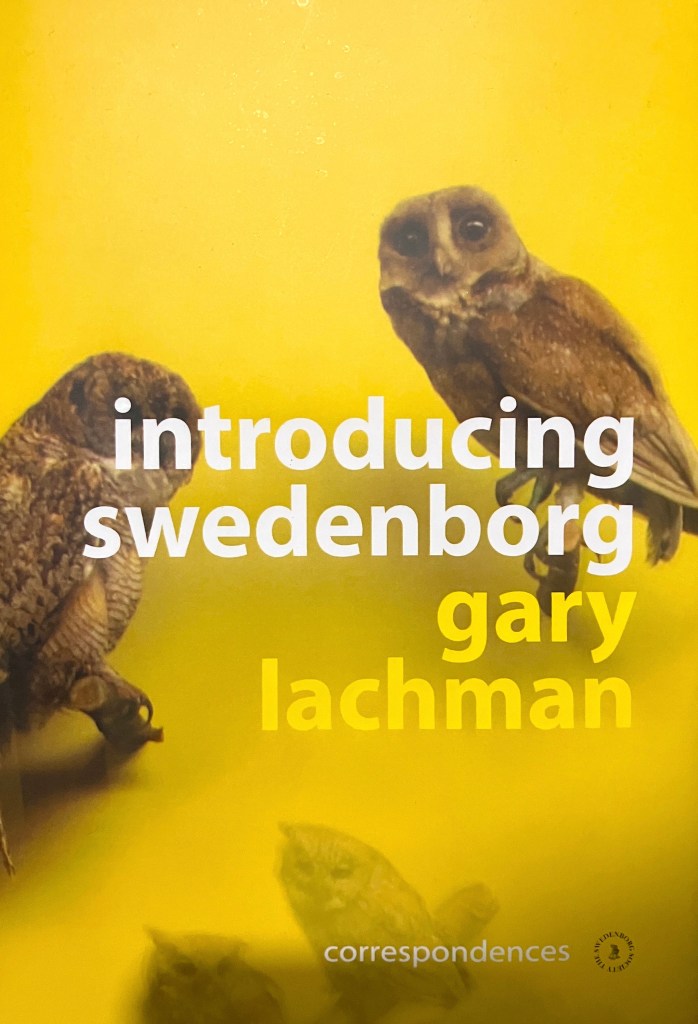
Gary Lachman, a highly acclaimed writer and expert on esoteric subjects, has said that one of the most important ideas and arguably the most influential that has come down to us from Swedenborg is his doctrine of correspondence. He claims that in addition to the theological, spiritual, and philosophical domains, it had a profound impact on the artistic, cultural, and even political ones. Swedenborg’s concepts of the regenerated man and the connections between heaven and earth influenced radical ideas, including those of the French Revolution, which took place less than 20 years after his death in 1772.[Gary Lachman, Correspondences p.1-2]
Lackman [ibid p.3] maintains that the most successful adaptation of Swedenborg’s doctrine of correspondence appeared in the Symbolist movement of the late 19th century in poets like Mallarme, Rimbaud, and in painters like Gustave Moreau (and I would argue Arnold Böcklin, and composers like Claude Debussy. These influences remain with us today. However, Lachman points out that symbolism was based on somewhat of a misunderstanding – or at least a modification – of Swedenborg’s idea by our friend Baudelaire, who was a hero to the Symbolists as well as many future generations of artists and writers.
Lachman notes that one of Swedenborg’s key points is that ‘‘ the kind of world we inhabit either here or in the afterlife depends on the kinds of thoughts we entertain; one corresponds to the other, as Swedenborg said, “Heaven and hell are inside us.” However, Swedenborg did not associate any of this with worldly riches; these arrangements were spiritual, not material [p.3].
Simply put, the doctrine of correspondence states that everything in the natural world—minerals, plants, animals, stars, and planets—is related in a specific way to the higher spiritual worlds.
The whole of the natural world corresponds to or has a counterpart in the spiritual world, not only in general but also in single details.
Lachman asserts that, for Swedenborg, the familiar everyday world of space-time and matter, meticulously explored by modern science down to its elementary particles, is fundamentally rooted in the spiritual world. According to Swedenborg, if the correspondence between the natural and spiritual realms were to be disrupted, the natural world would cease to exist instantaneously, much like the vanishing of an image in a mirror if its original source were suddenly removed. Swedenborg emphasizes the dependence of the natural world on the spiritual world, likening it to the relationship between cause and effect. Just as there is an inherent link between a creator and their creations, so too is there a crucial connection between the spiritual world and our physical reality. This profound interconnection suggests that the spiritual and natural worlds correspond with one another profoundly and intricately. [p.6-7] ‘It must be recognized,” Swedenborg tells us, “that the natural world comes into existence and maintains that existence from the spiritual world, just like an effect from the cause that brings it about’.
About hierarchies
An older concept known as the ‘great chain of being’ exists. This is a precise, sacred hierarchy of matter and spirit. God is the starting point, followed by angels, demons, stars, the moon, kings, princes, nobles, commoners, animals, plants, valuable stones, metals, minerals, earth, and dust. Each link in the chain can be further broken down into its own particles. The chain of being is hierarchical, starting with the foundational elements and ending with God, the utmost perfection. In the chain, God is at the top and the angels are below him, both in spirit form.
Earthly flesh is malleable and fallible, while the spirit is unchanging and permanent. Generally, we cannot alter an object’s position within the hierarchy. The field of alchemy, where practitioners attempt to transform basic materials like lead into higher elements like silver or gold, is an exception.
Swedenborg’s notion of correspondence can at least partially be mapped onto that, or even seen as an update, as his idea is not rigid but permeable. In his vision of reality, our material world is on the lowest rung of a kind of ladder of worlds, with higher ones reaching above us into realms beyond the physical. This tendency toward hierarchical patterns is rooted in the Western esoteric tradition to which Swedenborg belongs. With the divine at the top and successful stages below, these higher worlds participate in our world and bear similarities to it, albeit in different forms.
Swedenborg unequivocally upheld his Christian faith, despite diverging from traditional Lutheran theology. He introduced the doctrine of correspondences to unveil the concealed significance of the Bible, termed as an ‘esoteric reading’. In his view, the Bible should not be construed as a literal historical record, but rather as a symbolic representation of spiritual truths through everyday objects. Just as Swedenborg delineated different levels of reality, from celestial to spiritual and natural worlds, he also recognized varying levels of meaning within scripture. Although his ambition was to subject the entire Bible to this esoteric reading, he completed this daunting task for only Genesis, Exodus, and the Book of Revelation.
Of course, the idea of reading the Bible metaphorically rather than literally was not new, and neither were esoteric readings of the Bible. However, it was exceptional for the ‘modern’ 18th century. Swedenborg’s esoteric approach was unique in that it was highly subjective. We frequently conceive of the 18th century as being deeply rooted in the scientific revolution, with the concepts of evidence-based knowledge and proof-led evaluation, yet esoteric knowledge has a different derivation. Esoteric studies cannot ‘prove’ knowledge in the same way as mathematical formulas or historical truths. The evidence does not come in that way. Esoteric knowledge falls under what may be dubbed ‘feeling’; therefore, we might consider that esoteric knowledge is not about being correct or incorrect but rather as a tool to comprehend oneself and the cosmos. The contrast between this kind of learning and knowledge with Swedenborg’s own scientific work in geology and metallurgy is fascinating.
Baudelaire certainly took the subjectivity of esotericism and ran with it. Baudelaire was never a serious scholar of the esoteric, more of a dabbler, though he was certainly interested in and inspired by it. Baudelaire’s self-proclaimed Satanism is well-known, even infamous; French censors prohibited Les Fleurs du Mal as an insult to public morals. Later critics of Baudelaire, however, do not interpret his work as endorsing evil. As Walter Benjamin stated, ‘Baudelaire’s Satanism must not be taken too seriously.’ For Benjamin, Baudelaire’s writings about Satan exemplified radical nonconformity, an approach that Per Faxneld investigates in depth in his Satanic Feminism, looking at the 19th-century idea that Satan is an ally in the struggle against tyranny, patriarchy, or oppression. [Faxneld, 2017; Oxford University Press]
According to Gary Lachman, it’s unclear how much of Swedenborg Charles Baudelaire actually read. It may be that he had a French translation of Swedenborg’s most popular book, Heaven and Hell, but to Lachman, it seems that much of his knowledge of Swedenborg’s ideas came from his reading of Balzac. Balzac was a genuine scholar of Swedenborg and explored Swedenborg’s philosophies in some of his books. Baudelaire took Swedenborg’s doctrine of correspondences and combined it with ideas coming from two other writers who had a great influence on him, both of whom were also interested in Swedenborg: ETA Hoffman and Edgar Allan Poe. [Lachman, p.48]
From Hoffman, says Lachman, Baudelaire took the notion of synesthesia, which is something that Hoffman appears to have been prone to (the idea that one can hear colours and see sounds). This is a kind of correspondence that Baudelaire mines frequently in his poetry.
There are perfumes fresh like the skin of infants
Baudelaire, Correspondances
Sweet like oboes, green like prairies,
—And others corrupted, rich and triumphant
Though there is no evidence that he ever actually read Swedenborg, Edgar Allan Poe’s work appears to have absorbed various Swedenborgian ideas, allowing him to explore them in some of his stories. Baudelaire, influenced by these two writers, adopted the concept of the poet as a seer or mystic, attuned to the subtleties of reality. Taking inspiration from Swedenborg, Baudelaire transformed the idea of correspondences from a vertical ladder to a lateral, simultaneous connection between the senses. These correspondences became a hidden language decoded by the poet, offering sensual delight rather than pointing to higher, non-sensory worlds (Lachman, p.53).
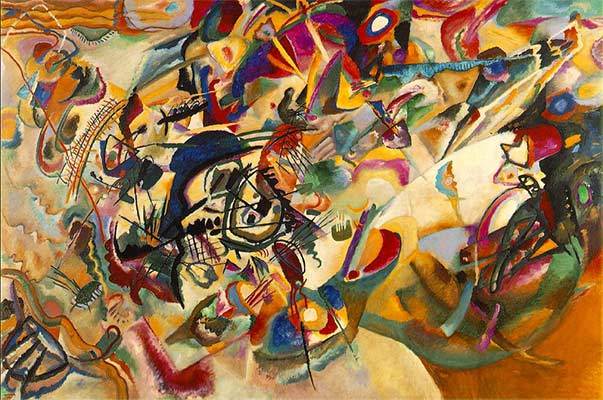
The interesting thing, though, is that as much as Baudelaire mapped out his own notion of correspondences, which have continued to be influential, Swedenborg’s original ideas are continually revived. We can see the link between the material and the layers of spiritual being in many works of the symbolists, and certainly we can see it in the paintings of Kandinsky. Possibly one of the most eloquent expressions of Swedenborg’s idea. Contemplating Kandinsky’s paintings brings us bodily through the physical material experience of the oil-on-canvas painting into that truly metaphysical world; this is at the core of all great abstraction. And that is a topic for another essay.
 Art and Magick