
An evening with Valentin Gerlier
and my thoughts on the stimulating and provocative talk!
A few weeks ago, I was privileged to attend a lecture by one of the most interesting thinkers of the arts active today, Valentin Gerlier. He is an ‘expert’ – if that is the right word – on the Imagination.
“Resolute imagination is the beginning of all magical operations” Paracelsus
In our industrial/postindustrial society, which is still run along largely Gradgrindian lines, using one’s imagination is often seen as taking a fanciful flight away from reality. However, more ancient traditions considered the creative imagination as a means of enhancing our grasp of the real world rather than fleeing it. The creative and artistic use of the imagination were thought to be one-of-a-kind, introspective, and often transforming ways of illuminating the depths of reality and leading humans to an understanding of its divine ground.
Valentin Gerlier introduced some of the fundamental concepts of this ancient worldview. What is there to envision, and what might it reveal? What do artists do when they fantasise, and how does this affect the Real – or True? What makes the artistic imagination distinctive and vital, and where does it fit in today’s world?
Gerlier claims that even thinking about what is the imagination is an act of imagination. Only the imagination may be accessible by itself. He claims that imagination “unfolds itself through its own process.” So, as you imagine, you discover a “kind of evanescent perfume of what the imagination might be”. This mental idea appeals to me: our conscious grasp of the imagination is only a whiff of what it truly is.
When we face reality, our imaginations come to life. That is, when we come into contact with the world in our human awareness, brain, or whatever, we truly co-create that reality – the real world – through the imagination. However, this binary opposition indicates that ‘the world’ exists but the imagination does not. This, according to Gerlier, is not the case.
Gerlier contends that the visionary imagination and its disclosures are real. The ability to imagine is a real one. It’s a skill that we all have, innately.
Humans used to talk about the imagination, and it appears that we have a hunger for imaginative thought. Nonetheless, we appear to know less and less about what it is. For example, when people remark, “That’s very imaginative thinking,” they mean “It’s a nice association of ideas I hadn’t considered before.” So it’s all about being creative – and that’s OK as far as it goes. But that’s not the kind of imagination Gerlier is talking about here.
Gerlier discussed the connection between the creative arts and the creative imagination. The creative imagination’s role is to show an amazing surplus to reality that only the artist can reveal. Apart from the fact that we don’t really grasp what imagination is, apart from a kind of internal mental connection of ideas, one of the reasons why it gets short shrift these days is that many of us have a tacit understanding that only the brute material is the truth. Truth must be something that isn’t vivid and visionary, but rather ugly, dissonant, and possibly violent. Consider how certain films’ most horrible sequences are described as ‘gritty realism’ (no matter how absurdly fictitious they are!)
Gerlier agrees that one look at the news would seem to plainly confirm that position, so in a way, the difficulty is that there is an attitude towards truth that assumes that something truthful and real must be something basic, demonstrably not good, possibly more ugly than it is beautiful. These happen before we realise it, and Gerlier point out, sometimes we say ‘yeah, that’s very well with your creative imagination, but you know I’m a realist, and this is what occurs in the world.’ The Truth is just about brutal survival.
Of course, this did not satisfy me or anyone else in the room! Gerlier then explained that pre-modern (pre-1Englihtment, pre-17thC) cosmological pre-modern ways of thinking about the imagination will offer us much more than postindustrial materialism.
Imagination is the middle voice of the universe.
“Imagination is the middle voice of the universe”. Gerlier’s point is that we need to think about the triad. About three fold realities and ways of thinking.
Since the 17th century we interpret reality as binary. One is the sensory realm where material Time, space and change and decay and eventually death; that’s the sensory realm. The other is the mental realm which is mind, thought. But in this binary, the connection is really complex; think of how we still struggle with Descartes ‘I think, therefore I am’. On the one hand, it makes sense, but on the other, we might ask, do we then think ourselves into embodiment ? Or – something else?
Gerlier proposes we go back to earlier traditions of thought.
This is a really important point because so often we think of philosophy and other things as being linear that because somebody in the 18th century said something then that negates everything that was said in the 17th century or earlier this is completely not correct in my own work on the sublime –which is something I might post about in the future– I found that going back to early 18th century writing on the sublime made me understand so much about the whole world of special effects in contemporary cinema and video game design –yes seriously!
Imagination is actually the deep structure of existence itself. Before the 17th century, what was intelligible, what was mind or intelligence, was as real as the tangible physical world, but it was real in a totally different way. Imagination was held to be a plane of reality, not just private thoughts in the head. The head is a receptor and a creator of that mindful plane, but it’s not just in the head. It’s bigger and deeper than our own thinking. He calls it a ‘partly active, partly passive capability that we have in ourselves.
Imagination is well expressed thought art; Gerlier shows William Blake’s Jacob’s Dream depicting the stairway to heaven. Blake’s stairway (used imaginatively by Michael Powell in his magnificent film A Matter of Life and Death) can be seen as a metaphor for the imagination – it joins the material to the intellectual – ‘the sensory to the intelligent, the earthly to the heavenly’ – but it is a real thing in itself. Maybe even realer and sturdier – for bridges and staircases need to be extremely sturdy!
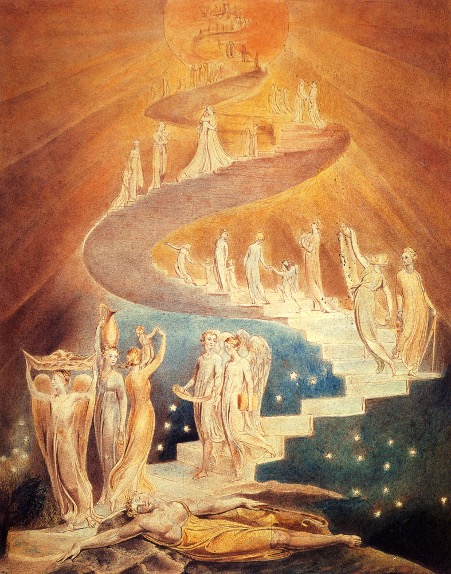
Figure 1Jacob’s Ladder, or Jacob’s Dream, illustration to the Bible painted for Thomas Butts, Genesis, xxviii, 12; Jacob lies in foreground left dreaming, behind him rises spiral staircase amid stars and golden rays above, three women stand at foot of staircase. 1799-1806.
Towards formalism
Gerlier talks about the de-spiritualisation of nature/reality and the shift to formalism. From the 17th century to the end of the 19th century and the start of the 20th, there is a shift. In the past, people thought that art should reflect the likeness of nature, or truth. Reality and nature may be better words to use, and they were used interchangeably in the past. This is why the pre-modern view of art was that it imitates reality and makes something that looks like reality. As the 19th century began, however, art changed into a new phase where expression became more important. I don’t mean expressionism. What I mean is emotional vision, a style in which the focus shifts from what the artist sees to what the artist is. Instead of showing what reality is like, the artist paints what they feel in their heart, mind, and soul. This makes the artist’s idea more important than showing reality as it really is. In his writing, Gerlier talks about Casper David Freidrich and his amazing views of what looks like nature but is actually more than that because it’s a person’s inner vision showing itself.
Gerlier goes on to say that art moved from the outside (material reality) to the inside (interiority), and then to a third stage, Formalism, that is about art and its internal logic. At that point, making art is about the thing itself; it doesn’t need to be connected to reality or to the artist’s own feelings. This means that in three steps, we go from the outside to the inside to something conceptual and intellectual
But there is a problem with this, or with seeing it like this. If Reality, or material things, are no longer the way that artists, writers, and finally spiritual seekers focus their attention then the world, in all its forms, doesn’t seem to be the locus anymore. Does this then mean it’s not a world that is lit up by creative and spiritual principles? In pre-modern times, nature seemed to be a visible way to connect with God. But when that connection between the divine and the earthly, between the spiritual and the natural, starts to break down, reality, or nature, loses its spiritual meaning. This means that painting pictures of nature no longer has a spiritual meaning. The spiritual ground of reality is cut off.
But it is imagination that moves between the two realms of material reality and intellect or concept. And that is why we need to look more closely at it and value it. Gerlier discusses philosopher John Scotus Eriugena’s statement “Nature is all that is, and all that is not” and says that it reflects a philosophical perspective suggesting that everything, both the tangible and intangible, is encompassed within nature. It implies a comprehensive understanding of existence, blurring the distinction between what is considered as “being” and what is considered as “non-being.” Eriugena’s notion emphasizes an all-encompassing, inclusive view of reality where nature constitutes both the manifested and the unmanifested and this is organized by the imagination.
Gerlier gives the example of the journey from Cambridge to the cathedral town of Ely. When you arrive towards the cathedral, the cathedral is in the distance. As the train gets closer and closer, the cathedral reveals more and more of itself. when you see the cathedral very far away in the distance, your imagination is already at work seeing things that are not there; because you can’t actually see the whole cathedral, but your imagination is participating with you, already completing the sense of the cathedral and your imagination is already telling you there is more than what you see.
Gerlier’s talk brought me to consider further the role of the imagination in both making and experiencing art, and to consider the place of spirituality in the concept of imagination. Imagination is the capacity to form, combine, and manipulate mental representations of things that are not immediately apparent to the senses. Because of this, people can think of new ideas, imagine new possibilities, and engage in creative thinking. Creativity, problem-solving, and the development of abstract ideas are all underpinned by the intricate interaction of memory, perception, and mental representation that is imagination. From creative expression to scientific discovery, it is essential to many human pursuits.
The capacity to form, combine, and manipulate mental representations of things that are not immediately apparent to the senses is known as imagination. People are able to think of new ideas, imagine new possibilities, and engage in creative thinking because of this. Creativity, problem-solving, and the development of abstract ideas are all underpinned by the intricate interaction of memory, perception, and mental representation that is imagination. From creative expression to scientific discovery, imagination is essential to many human pursuits.
Whether or not one considers one’s imagination to be spiritual depends on their philosophical or religious stance. I place great emphasis on the creative and transcendental powers of the mind, seeing them as portals to other dimensions of reality or sources of inspiration from on high. Within this framework, one may argue that the imagination is a means by which one can tap into innate spiritual wisdom, cultivate original thought, and probe the mysteries of the cosmos.
Nonetheless, not all philosophical or religious perspectives automatically attribute a spiritual aspect to imagination, and there is a wide range of opinions regarding the subject. In my mind, it is right to emphasize the transcendent and creative aspects of imagination, viewing it as a link to higher realms of consciousness or divine inspiration. In this context, imagination may be considered a tool for connecting with spiritual insights, fostering creativity, and exploring deeper dimensions of existence.
In this respect I agree with Emanuel Swedenborg. Swedenborg believed that the imagination played a crucial role in human cognition and spiritual development. To him, the imagination is not just a product of sensory experiences but also a gateway to higher spiritual realities. He viewed the imagination as a means through which individuals can connect with the spiritual world and receive divine inspiration. Swedenborg regarded the imagination as a powerful tool for spiritual growth and connection with the divine. He encouraged individuals to harness their imaginative faculties in a disciplined and virtuous manner to explore higher spiritual realities.
Swedenborg emphasized the importance of using the imagination in a constructive and disciplined manner. He believed that by engaging in imaginative contemplation and visualization, individuals can deepen their understanding of spiritual truths and develop a closer relationship with God.
However, he also cautioned against the misuse of the imagination. He believed that indulging in excessive fantasies or allowing the imagination to be dominated by worldly desires could lead to spiritual confusion and detachment from higher truths.
In the triad of reality, imagination and intellect, where is magick located?
The concept of magick is often associated with the realm of imagination. In the triad of reality, imagination, and intellect, magick is typically seen as residing within the realm of imagination. Magick often involves practices, rituals, or beliefs that go beyond conventional understanding and tap into the imaginative and symbolic aspects of consciousness.
While some might argue that magick also involves intellectual understanding and manipulation of metaphysical forces, its essence often lies in the imaginative and symbolic realms where one seeks to influence or interact with realities beyond the ordinary. Of course, perspectives on magick vary widely, and interpretations can be influenced by cultural, spiritual, or philosophical beliefs. But in my reading of magickal histories and sacred texts, my imagination gets excited. And when I practice a magickal rite, it is my imagination that consolidates it into reality.
It’s vital to remember that the artists who pioneered abstraction were very spiritual. I’m thinking about Mondrian, who was a theosophist and studied several spiritual traditions. Kandinsky was also a theosophist. Even while some abstract expressionists were passionately absorbed in spirituality, they were not interested in depicting reality. I’d imagine that by then, the world had been so saturated with mass-produced images that there didn’t appear to be much sense in doing more of them.
However, I believe it is prudent to take a left turn and consider the esoteric legacy in art, which includes surrealism and many post-surrealist artists who operate in the esoteric domain. The heritors of Blake are many and they are increasing! Because so much of occult practice involves making that connection between the earth and the elements and higher concepts such as visions of the divine and the spirit world, these artists appear to embody that constant crossing of the bridge between the mental or intellectual conceptual and the material. The art created by artists who are interested in these themes very much embodies them. What I mean is that we shouldn’t pay too much attention to what the art market is touting, but rather look for artists who display the power of imagination to its maximum.
We do not see the world as it is, we see the world according to our instruments
Critique of Pure Reason (1781) Immanuel Kant
Dr Valentin Gerlier, scholar, writer and musician, is Senior Lecturer in Poetics of Imagination at Dartington Arts School. His latest publication is Shakespeare and the Grace of Words (Routledge, 2022). He is a member of the Academic Board of the Temenos Academy.
 Art and Magick